

Assembly methods must balance precision, sterility, throughput, and cost
When manufacturing medical devices in cleanroom environments, assembly methods must balance precision, sterility, throughput, and cost. The decision between manual and semi-automated assembly can significantly impact regulatory compliance, product quality, and scalability. Understanding the strengths and limitations of each approach is essential.


Understanding cleanroom assembly for medical devices
Cleanroom assembly is vital for products that must meet stringent contamination controls, particularly in Class I and II medical devices, diagnostic kits, and drug delivery systems. Within these sterile conditions, every movement, material, and human interaction can affect product safety and performance.
Choosing between manual and semi-automated assembly is not just a matter of budget or convenience. It requires a holistic view of product complexity, production volume, part tolerances, inspection protocols, and risk classification.
Manual assembly in cleanrooms: When it works best
Manual cleanroom assembly involves skilled technicians performing precise tasks by hand within a controlled environment. This approach offers high flexibility and is well-suited to early-stage production or clinical trials, complex assemblies that require dexterity or variable force, short-run or low-volume manufacturing, and processes that rely heavily on visual inspection or manual adjustment.
Manual assembly allows for quick design iterations, which is especially beneficial when the product is still evolving. It is also easier to validate and control in smaller operations. However, it places heavy reliance on operator training, consistent technique, and ergonomic workspace design. Labour costs can also be high over time, and human error is a potential risk factor in longer production runs.
The case for semi-automated assembly
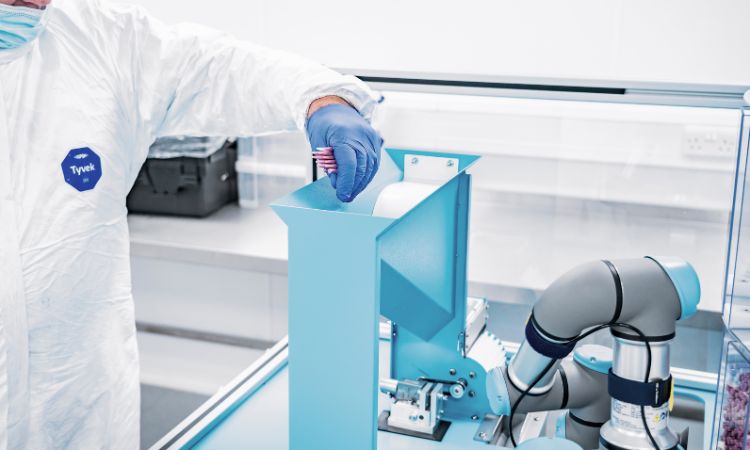
Semi-automated assembly systems combine operator input with mechanised tools, jigs, or PLC-driven processes to improve speed, consistency, and accuracy. This option is typically ideal when production volumes are rising, sub-assemblies are repetitive and labour-intensive, process control and cycle time consistency are key, and there’s a need for data logging, in-line inspection, or digital traceability.
Semi-automation reduces variability by standardising tasks that would otherwise be vulnerable to fatigue or inconsistency. In cleanroom settings, fewer manual movements also mean less contamination risk. While the initial investment is higher than manual assembly, the long-term return often outweighs the cost, particularly for mature products nearing commercial scale.
At Europlaz, we support clients in evaluating and implementing the right level of automation for their cleanroom operations. Whether it involves custom jigs, pressure-regulated fixtures, or PLC-controlled inspection steps, our team ensures seamless integration into your quality management system and ISO Class 7 environment.
Key factors that influence the right choice
Several critical factors determine whether manual or semi-automated assembly is the better fit. Product lifecycle stage plays a role in determining readiness for automation. Production volume helps assess return on investment for capital equipment. Component complexity impacts tooling and fixturing decisions. Regulatory compliance influences documentation and validation needs. And a careful comparison of labour costs versus capital investment helps identify the most sustainable path forward.
Often, the right strategy involves a hybrid approach – starting manually during development, then phasing into semi-automation once demand and design stabilise.
Build the right assembly strategy for your device
Whether you’re scaling up or just getting started, choosing between manual and semi-automated assembly in cleanroom environments is a pivotal decision. It affects not only your production efficiency but also your product’s compliance, quality, and cost trajectory.
Contact us to find out more about how Europlaz can support your cleanroom assembly needs with flexible, scalable solutions tailored to your device.
FAQs: Manual vs semi-automated assembly in cleanrooms
Which is more cost-effective: manual or semi-automated assembly?
Manual assembly is typically less expensive to start, but semi-automation becomes more cost-effective as volumes increase.
Is semi-automated assembly suitable for all cleanroom classes?
Yes, semi-automation can be implemented in Class 7 cleanrooms if designed for cleanroom compatibility and validated properly.
Can I switch from manual to semi-automated assembly mid-project?
Yes, but it requires careful planning to ensure validation, tooling compatibility, and regulatory continuity.
How does Europlaz support automation in cleanroom environments?
Europlaz designs, validates, and integrates bespoke semi-automated solutions that align with ISO and regulatory requirements while optimising output and reducing risk.

Download our brochure
Curious to learn more? Download our brand-new company brochure to discover how Europlaz is evolving and what it means to you.
Discover Europlaz
Our UK-based ISO 13485 certified and FDA-compliant cacility means that we have complete control of the process, from under one roof. We are flexible, and resourceful, and can take on projects of any size. Our clients range from small start-ups to international blue chip medical device suppliers.